Domino Anonymizer — a small tool for a recurring problem
Before sending NSD files, crash dumps, or server logs to HCL support or a consultant, you need to strip out sensitive data. Server names, user Distinguished Names, IP addresses, file paths — they're all in there.
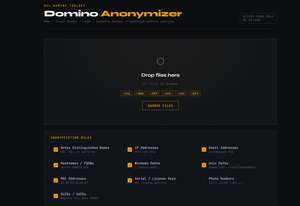
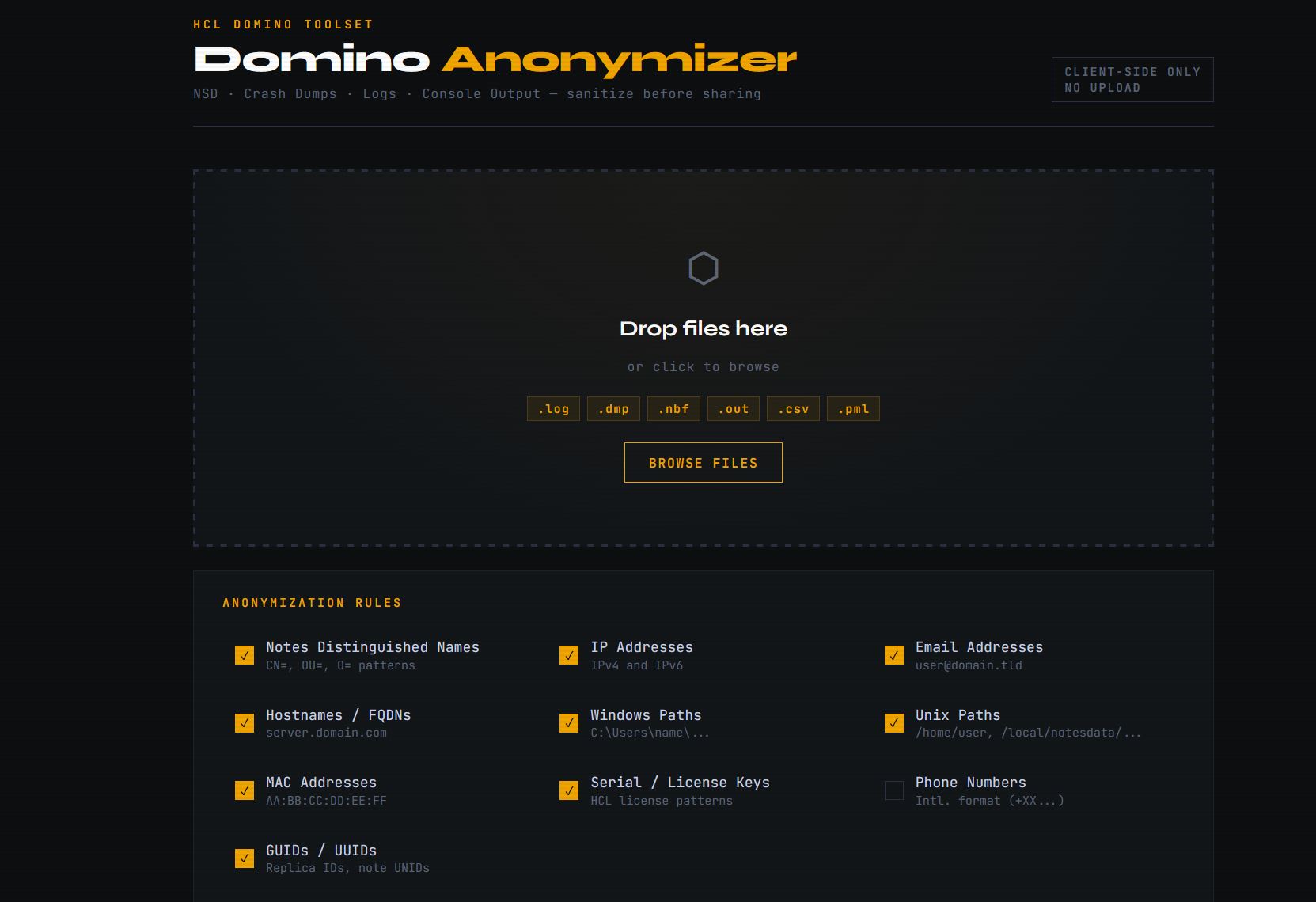
I built a standalone HTML tool that handles this client-side. Nothing is uploaded anywhere. You drop the files, choose which patterns to redact, and download the cleaned versions.
Supported formats: .log .dmp .nbf .out .csv .pml
Replacements are consistent — the same original value always maps to the same token across all files in a batch. The tool also exports an anonymization map as CSV, which you can share under NDA with the support team if they need to reverse a specific entry.
No framework, no dependencies, no install. One HTML file.
----------------------------
What it anonymizes:
| Pattern | Example → Result |
|---|---|
| Notes DN | CN=John Smith/OU=Finance/O=Acme → CN=USER_001/OU=DEPT_001/O=ORG_001 |
| IPv4 | 192.168.1.50 → 10.0.0.1 |
| IPv6 | fe80::1 → fd00::001 |
| Emails | jsmith@acme.com → user001@anon.example |
| FQDNs | domino1.acme.com → server-001.example.com |
| Windows paths | C:\Users\jsmith\ → C:\Users\WINUSR001\ |
| Unix paths | /home/jsmith/ → /home/unixuser001/ |
| MAC addresses | 00:1A:2B:3C:4D:5E → anonymized |
| GUIDs/Replica IDs | 32-hex UNIDs, UUID format |
| License/Serial keys | alphanum groups with - |
Key features:
- Consistent mapping — same original value always gets the same token across all files in a batch
- Binary files (.dmp, .nbf) — handled via latin-1 byte-safe round-trip, ASCII strings replaced in place
- Anonymization map downloadable as CSV — so HCL/IBM support can reverse specific values under NDA
- Checkboxes to enable/disable each rule category
- "anon_" prefix on output filenames so originals are never overwritten
DOWNLOAD
Contact_ dperarnaud [@] data101.es